
The finance ministry has said that the Goods and Services Tax will not apply on room rents of 'sarais' (inns) or properties managed by religious and charitable institutions. The clarification was issued by the Central Board of Indirect Taxes and Customs (CBIC) on Thursday evening to clear the confusion with regard to the levy of GST on room rents. This clarification by the Finance Ministry came following a demand from various quarters including AAP MP Raghav Chadha that the GST on rooms rented by religious institutions be withdrawn.

Exporters on Thursday demanded fiscal incentives, tweaking in customs duties on certain products and credit at affordable rates in the forthcoming Budget to boost exports and create jobs. In a pre-budget virtual meeting with Finance Minister Nirmala Sitharaman, the Federation of Indian Export Organisations (FIEO) said the depreciation of the rupee against the US dollar is affecting exports' competitiveness and the sector requires more support. "Creation of employment is the biggest challenge faced by the country...We would urge the government to provide fiscal support to units which provide additional employment in the export sector," the exporter's body said.

Deadline ends, after two extensions and only 70% file detailed return for July

By doing away with the 1 per cent inter-state tax over and above the GST rate, the government has met one of the three key demands over which Opposition Congress has been blocking the Bill in the Upper House

Industry body CII on Thursday made a case for pushing reforms in sectors like land, labour, and agriculture by the Modi 3.0 government to accelerate economic growth, which is estimated to be around 8 per cent in the current financial year. CII president Sanjiv Puri said a lot of policy interventions in the past have put the economy on "a much stronger wicket". "The growth rate is poised to touch 8 per cent during the current year, marking the fourth consecutive year of above 7 per cent + growth.
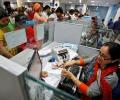
Banks have been demanding a single centralised registration system, like at present, as they feel multiple registrations would create procedural and compliance problems.

'You may see some movement indicating a simpler tax regime with less exemptions but with fewer tax rates making life simpler for taxpayers.'

There will be a dramatic alteration in the role the Centre and the states will play to shape India's fiscal and economic destiny, report Nitin Sethi and Ishan Bakshi.

In its essence, GST is a national level system of value added taxation of goods and services, says Shankar Acharya.

'... the government provides adequate cash and kind support for the poorest of the poor for survival... ...conditional cash and skilling support for the economically poor to raise their incomes to adequate levels... ...and make functional arrangements for providing unemployment allowance to the vulnerable poor during disasters like the present one.'

The implementation of the GST will indeed be a landmark reform.

Modi said there were a slew of 'matching priorities' between the business council and that of his administration, including dismantling trade barriers, promoting skills development, establishing manufacturing supply chains and infrastructure development.

Snapping the two months slide, the country's merchandise exports rose marginally by 0.5 per cent to $34.58 billion in September while trade deficit narrowed to $20.78 billion. According to official data released on Wednesday, imports increased by 1.6 per cent to $55.36 billion in September compared to $54.49 billion in the year-ago period. The trade deficit, or the gap between imports and exports, was $20.8 billion during the same month last year.

Goods like chocolates, chewing gum, shampoo, deodorant, shoe polish, detergents, nutrition drinks and marble will now attract 18% GST>

Jaitley said the GST Composition Scheme, under which small traders and businesses pay a 1 per cent tax based on turnover, can be availed by businesses with a turnover of Rs 1.5 crore, against the earlier Rs 1 crore, with effect from April 1.

'If petro products are brought into GST, then there will be minor impact on the incidence of tax... and minor impact on prices. The price of petrol, diesel will continue to be driven by global factors'
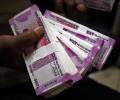
The budgeted indirect tax collection target is Rs 9.26 trillion, and the Centre has collected around Rs 5 trillion in the first 8 months. So it needs another Rs 4.2 trn in the last four months

Rahul Gandhi, who is scheduled to again visit poll-bound Gujarat from Saturday, said the government can't break the back of small and medium businesses, crush the informal sector and destroy millions of jobs.

The UK India Business Council expects more emphasis to be put on improving bilateral economic ties.

As per practice a vote-on-account or approval for essential government spending for a limited period is taken in the election year and a full-fledged budget presented by the new government.
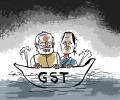
If the items and services such selected subsequently pass the test from the fitment committee and the GST Council, this would be the first of such rate hikes, after a series of cuts in the process of rate rationalisation that started in November 2017.

Heeding to demands made by several states, the GST Council on Friday put on hold a decision to hike the tax rate on textiles to 12 per cent and referred to a panel of state ministers to recommend rate by February, Union Finance Minister Nirmala Sitharaman said. The panel, the highest decision-making body for indirect taxes, met under emergency provisions after states made a request for deferring the tax rate hike on textiles, from the current 5 per cent, to be effective from January 1, 2022. Currently, the tax rate on manmade fibre (MMF) is 18 per cent, MMF yarn 12 per cent, while fabrics are taxed at 5 per cent.
Bihar Deputy Chief Minister Sushil Kumar Modi said, a hike in GST rates would have hampered consumption amid the economic slowdown. The revenue augmentation panel in the Council meeting recently recommended revisiting and restructuring the GST rate slabs, besides correcting the inverted duty structure. The panel listed 24 items, including mobile phones, footwear, fabrics, LED light, medical equipment, utensils, agri machinery, pharma, and renewable components, which have an inverted duty structure, resulting in refunds of close to Rs 20,000 crore annually.

The challenges before the government, he said, is to put public sector banks back on track and continue to operationalise stalled infrastructure projects

This will violate the time-honoured convention that a government elected for a five-year tenure presents only five full Budgets, but the NDA government will no doubt present it as yet another initiative of Mr Modi.

A government report revealed that fake companies floated with fake addresses, issued fake GST invoices and generated fake e-way bills, with fake vehicle registration details without supplying any goods causing huge loss to the exchequer.
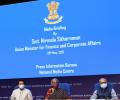
The GST Council on Friday left taxes on COVID-19 vaccines and medical supplies unchanged after the BJP- and Opposition-ruled states sparred over whether tax cut benefits will reach the common man. Congress and other Opposition ruled states have been demanding a reduction in taxes but the central government felt the move may not result in tangible gains for people. "It is one thing to rush to say - do this, it will benefit the common man. But when the technical, fitment and law committees go into the details, you realise that that could have collateral impact on many others," Finance Minister Nirmala Sitharaman said. "I am not talking about the revenue generation aspect, but how many other items will get included in it as a result of which how you are going to implement it," she added.

The government introduced the 122nd Constitution amendment Bill.

States will have exclusive control over all dealers up to a revenue threshold of Rs 1.5 crore in a year

The Centre and states are looking to further tighten the GST registration process and legal measures to deal with the rising cases of fake invoicing. A meeting of the law committee of the GST Council has been convened on Wednesday to discuss these issues, finance ministry sources said. The committee, comprising senior central and state tax officers, would also discuss the GST fake invoice frauds, further tightening of the GST registration process and work out other legal measures including necessary law amendment required in the GST Act to curb the menace of fake invoicing, they added. Also the provisions related to deemed registration under Goods and Services Tax (GST) law may be tightened to prevent the misuse of such provisions by fake dealers and the provisions related to suspension of registration may also be streamlined to make the procedure of suspension and cancellation of registration more efficient and faster, so that such fraud operators can be prevented in time from continuing to pass on fake credit down the chain.

Plug-in hybrids have two engines and the electric part has a much larger battery than in the regular hybrids. Car companies, led by the Japanese, are pushing the Indian government to look at hybrids in the interim if it wants to reduce carbon emission.

The panel decided to omit the reverse charge mechanism (RCM) clause from the GST law under which registered taxpayers buying from unregistered taxpayers have to deposit the GST.

The stock of the country's largest passenger vehicle maker, Maruti Suzuki India (MSIL), has been hitting successive all-time highs over the past three trading sessions. The rally in the scrip has helped it notch over a 21 per cent gain since the start of February, outperforming the National Stock Exchange Nifty Auto Index. The gains for the leader of small passenger cars have been more recent, as the company still trails the Nifty Auto over one- and two-year periods.
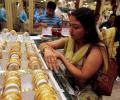
Jewellers in India, the world's second largest gold consuming country after China, have started receiving more inquiries for purchase of gold or silver immediately after the Reserve Bank's announcement to withdraw Rs 2,000 notes from circulation. However, there is no panic buying of the precious metal unlike the situation witnessed in 2016 during demonetisation, jewellers body GJC said on Sunday. In fact in the last two days, the actual gold purchase has been less in exchange of Rs 2,000 notes due to strict Know your Customer (KYC) norms although sources said some jewellers have started charging a 5-10 per cent premium, taking the gold prices to Rs 66,000 per 10 grams level.

Higher reliance on GST receipts for revenue reduces states' autonomy as these receipts depend on tax rates decided by the GST Council, a report by Delhi-based non-profit, PRS Legislative Research shows.

"To begin with, people could face some difficulties because any changeover has its own problems. But it will settle down and the country will benefit from the new indirect tax regime," Jaitley said at an event organised by ABP News.
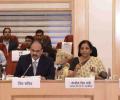
After the GST Council's meeting in March, the Centre had sought views from Attorney General K K Venugopal -- who is the chief legal officer of the government -- on the legality of market borrowing by the council to make good any shortfall in the compensation fund. The AG in his view said there is no obligation on the central government to pay the GST compensation shortfall, according to the sources.

The theatres will start functioning from Friday with the ticket prices set to go up from the present maximum of Rs 120 with the addition of 28 per cent of Goods and Services Tax.

The Lok Sabha has already passed the Bill.

Neutrality and jurisdiction in international trade need to be discussed threadbare before GST is implemented in India.
